
From Street Art to Online Slot: How Gonçalo MAR Created Yokai’s Visual World for BGaming
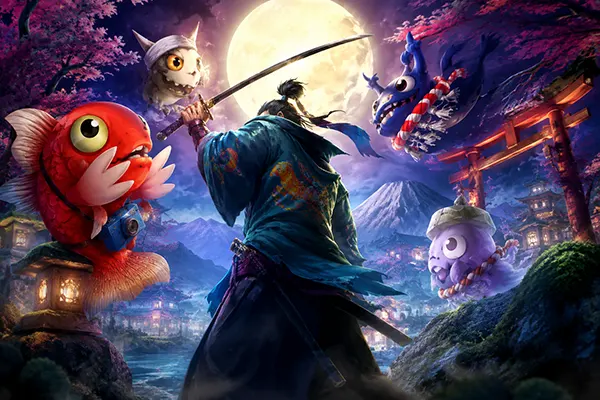
Released on 6 July 2026, Yokai is the first title in BGaming’s ART Collab series and an unusual example of a slot being developed around an artist rather than having artwork added to a finished concept. Portuguese street artist Gonçalo MAR helped shape its characters, setting and visual identity from an early stage, turning elements of his established style into a Japanese-inspired game world.
How a Lisbon Street-Art Partnership Became a Slot
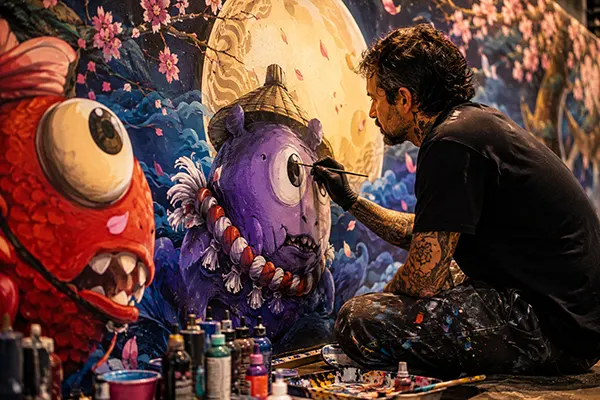
Gonçalo MAR, born in Lisbon in 1974, has worked across fashion design, animation, graffiti and mural art. His style combines comic-book imagery, animation, Japanese cultural influences and street-art techniques, often filling large compositions with brightly coloured characters and surreal details. BGaming first encountered his work through an exhibition in Lisbon and subsequently developed a creative relationship with the artist.
That visual identity is particularly important once a slot leaves the artist’s studio and appears among dozens or hundreds of other games. Visitors to an online casino normally make their first judgement from a game thumbnail, title and opening screen before they know anything about its mechanics. A catalogue at Nolimit Way casino, where online slots are presented alongside blackjack, roulette, poker and live casino games, illustrates the kind of environment in which distinctive artwork has to attract attention without making the game difficult to understand.
Yokai was developed differently from many conventional slots. BGaming game designer Ruslan Shakhlovich explained that a studio would normally begin with a game concept or mechanic and create the visual treatment around it. MAR became involved before that process had been completed. The developers discussed what made his work recognisable, while the artist had to consider practical requirements that do not exist when painting a mural, including symbol clarity, animation timing and limited screen space.
Turning Gonçalo MAR’s Characters into a Playable World
MAR’s characteristic “finger-fish” figures became more than decorative references to his street work. His Turista character appears on the reels and also influenced the changing heads of the game’s main figure. BGaming added an interactive element that allows the character to switch between several finger-fish variations, while other figures appear during the transition into the bonus sequence.
The Samurai developed from the same art-led approach. Instead of remaining a static illustration beside the reels, the character cuts through the moon with a katana when the bonus round begins. Small yokai spirits also appear and disappear around the playing area during calmer moments. They do not affect the mathematical outcome, but they help connect the reels with the wider setting and make the scene feel less like a collection of unrelated symbols.
Moving MAR’s visual language from walls to screens created practical limits. A mural can contain details that people notice gradually, whereas a slot viewed on a phone must remain readable almost immediately. Some compositions therefore had to be simplified, and several animation concepts were rejected because they distracted from play. Development took roughly nine months, around 30–50% longer than a typical BGaming production, as the artist and development team adapted to each other’s working methods.
Why Japanese Folklore Fits MAR’s Visual Language
Japanese references were not simply added to MAR’s work for Yokai. His existing artistic language already incorporates influences from Japanese culture alongside comics, animation and urban art. BGaming used folklore as the foundation for the setting without attempting to reproduce traditional Japanese art, allowing MAR’s contemporary characters to remain recognisable within a world populated by spirits, moon imagery and a supernatural Samurai.
The story places the action near an ancient forest beneath Mount Fuji. The Samurai is described as the son of the Sea Dragon King and the Mountain Fairy, protecting the forest together with fortune-bearing yokai spirits. This background gives the characters a relationship with their surroundings and helps the moon, wandering spirits and bonus animations feel connected to a single visual idea.
The game itself uses five reels and 20 paylines, while several features are incorporated directly into the artwork. Blue and red Wild symbols contribute to combinations, and red Wilds can carry multipliers of up to +10. Before the Free Spins feature starts, nine moons are cut open to reveal values that determine the number of spins, making the Samurai’s action part of the game feature rather than a separate decorative sequence.
What Yokai Says About Art-Led Slot Design
Yokai has a published RTP of 97%, medium-high volatility and a maximum win of 8,000 times the stake. These figures describe its mathematical profile, but they are not the reason the release stands apart. What makes the project unusual is that the artwork influenced characters, transitions and interactive details before the final form of the game had been established.
The collaboration also demonstrates why putting an artist’s name on a slot is not necessarily the same as integrating that artist’s work. Street art depends heavily on authorship and a recognisable visual language. MAR participated early enough to influence the finished experience, while BGaming still had to maintain the clarity required for reels, controls and smaller displays. The result sits between artistic expression and the practical requirements of casino game design.
For BGaming, Yokai is intended as the beginning of the ART Collab series rather than an isolated experiment. Its more interesting legacy may therefore be the production method. Instead of asking an artist to decorate an already defined slot, the project demonstrates how an existing artistic world can influence the setting, characters, animation and small interactions from the earliest stages of development.