
Gambling in Belle Époque Art: Casinos, Resorts and High Society in the Late 19th Century
The late nineteenth century transformed gambling from a private pastime and a feature of traditional spa towns into part of a much broader culture of travel, entertainment and social display. During the period commonly associated with the Belle Époque, elegant resorts attracted aristocrats, industrialists, artists, performers and wealthy travellers from across Europe. Casinos stood beside grand hotels, theatres, gardens, promenades and railway stations, creating places where leisure could be seen as well as enjoyed. Painters, illustrators, photographers and poster designers responded to this changing society. Some represented card games directly; others concentrated on fashionable crowds, seaside holidays, racecourses, theatres or the architecture that surrounded gambling. Together, their work shows that the casino was never simply a room containing gaming tables. It belonged to a larger visual culture of dress, status, travel, spectacle and modern public life.
Casinos as Social Stages of the Belle Époque
The great European casino resorts developed their identities long before the final decades of the nineteenth century, but the Belle Époque gave them a particularly recognisable image. Monte Carlo became the clearest example. The Société des Bains de Mer was established in Monaco in 1863 under Prince Charles III, and the district around the casino soon grew into an international resort. Hotels, landscaped gardens, restaurants and entertainment venues turned a formerly sparsely developed area into a destination associated with wealthy foreign visitors. Rail connections were crucial because they made journeys from cities such as Paris considerably easier. The casino therefore belonged to the same modern transport culture that was changing seaside tourism and spa travel elsewhere in Europe.
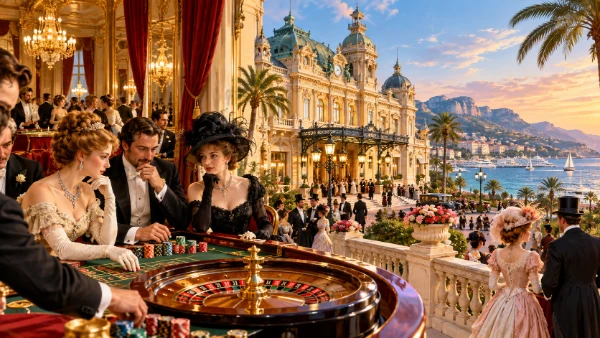
Monte Carlo’s architecture helped turn gambling into a spectacle even before a visitor reached a gaming table. Major rebuilding took place in 1878 and 1879, when Charles Garnier, already famous for the Paris opera house, worked on the casino complex and its theatre. The Salle Garnier opened in January 1879 with Sarah Bernhardt appearing at the inaugural event. Other rooms followed as demand grew. The result was a setting in which gaming, theatre, music, dining and social display existed within the same carefully designed environment. Chandeliers, decorated ceilings, columns, mirrors and elaborate interiors made the building part of the entertainment. Visitors were not only taking part in games; they were also watching one another and being watched.
This connection between gambling and public appearance is important when looking at Belle Époque art. Artists did not need to paint a roulette wheel to represent casino society. Evening clothes, promenades, hotel terraces, carriage arrivals and groups gathered in public interiors could all signal the same social environment. A resort was a place where class and wealth became visible through clothing, behaviour and access to particular spaces. For painters interested in modern life, such scenes offered rapidly changing light, movement and human interaction. For photographers, the monumental casino façade and its surrounding gardens provided evidence of a new type of luxury architecture. The visual history of gambling therefore extends beyond pictures of games themselves.
Monte Carlo and Baden-Baden: Two Different Resort Histories
Monte Carlo became especially important during the later nineteenth century because its casino continued to expand while gambling elsewhere faced legal restrictions. By the 1880s and 1890s, the Monaco resort had developed an international reputation that combined gaming with opera, concerts, restaurants and luxury accommodation. Surviving photographs provide unusually direct evidence of its appearance. The Musée d’Orsay, for example, holds photographs made by Gustave Eiffel between 1890 and 1892 showing the central casino building, its façade, terraces, waterfront and neighbouring streets. These small photographs are valuable because they record Monte Carlo not as an imagined symbol of luxury but as a physical place being observed by a major figure of the industrial age.
Baden-Baden followed a different course. During the middle decades of the nineteenth century, the German spa town had been one of Europe’s most celebrated centres of gambling and fashionable society. Its Kurhaus, built between 1821 and 1824 and later enlarged and richly decorated, attracted an international public. Fyodor Dostoevsky visited Baden-Baden and experienced the casino culture that became closely associated with his life and writing. Musicians, writers, diplomats and members of ruling families also came to the town. Yet gambling at Baden-Baden ended after the 1872 season because of the prohibition affecting German casinos. The gaming rooms did not reopen until the twentieth century.
That closure makes Baden-Baden particularly useful for understanding the relationship between casinos and resort culture. The end of gaming did not remove the town from fashionable European life. Concerts, balls, thermal bathing, gardens, hotels and social gatherings continued, while new facilities appeared. The Friedrichsbad opened in 1877, and the town continued developing as a spa destination during the following decades. The history shows that gambling was one component of a much larger leisure system. Once the gaming tables disappeared, many of the rituals and spaces associated with elite sociability remained. Art of the period often reflects precisely this broader environment rather than gambling in isolation.
How Artists Represented Gambling and Resort Life
Direct representations of casino play form only part of the artistic record. Late nineteenth-century artists were often more interested in human behaviour than in explaining the rules of a game. Card tables allowed painters to examine concentration, silence, gesture and relationships between figures. Paul Cézanne’s celebrated series of card players, produced during the 1890s, is an obvious example of how card play could become a serious artistic subject. His figures are not elegant casino visitors, and the pictures should not be treated as literal records of Monte Carlo-style gambling. Their importance lies elsewhere: they demonstrate how an activity associated with leisure and possible wagering could be stripped of theatrical glamour and turned into a study of posture, attention and social interaction.
Other artists approached modern leisure through racecourses, cafés, theatres and music halls. Edgar Degas repeatedly represented horse racing, spectators and the social world surrounding the track. Betting formed part of nineteenth-century racing culture, yet his pictures rarely turn the financial act itself into their central subject. Instead, they show horses, riders, owners and spectators within a modern leisure economy. This indirect approach is relevant to casino imagery as well. The artistic interest frequently lay in anticipation, observation and social performance rather than in money changing hands. The visual signs around gambling could reveal as much about the period as the game itself.
The development of modern illustrated posters added another dimension. By the 1880s and 1890s, improvements in colour lithography helped large advertising posters become a striking part of urban streets. Jules Chéret was particularly influential, while artists including Henri de Toulouse-Lautrec, Théophile-Alexandre Steinlen, Pierre Bonnard and Alphonse Mucha helped turn commercial poster design into a recognised artistic field. These posters advertised theatres, cabarets, products and public entertainments. Although not every example concerned casinos, the visual language they created — bold silhouettes, elegant figures, movement and vivid scenes of leisure — belonged to the same culture that sold fashionable resorts to an increasingly mobile public.
Seaside Painting and the Fashionable Crowd
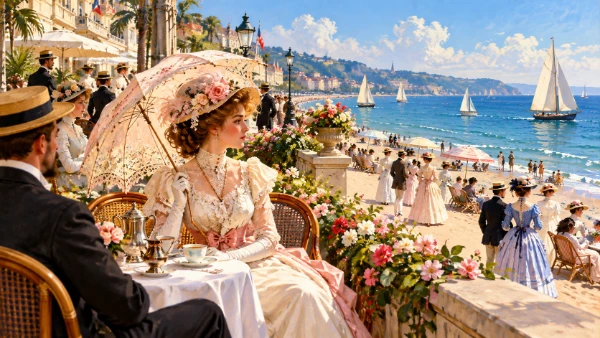
The Normandy coast provides some of the clearest artistic evidence of the emergence of resort society. Eugène Boudin began painting fashionable crowds on the beaches of Trouville and Deauville in the 1860s. Works such as his beach scenes show men and women in formal clothing standing or sitting near the sea rather than presenting the beach simply as untouched nature. Parasols, dresses, hats and groups of visitors occupy as much attention as the weather. The Metropolitan Museum of Art’s On the Beach at Trouville, dated 1863, belongs to this body of work, while the Musée d’Orsay preserves several Boudin views connected with Trouville.
Boudin’s pictures are particularly relevant because they show how tourism changed what artists considered worthy of attention. A beach could now be a social interior without walls: a place for observing clothes, manners and relationships. Claude Monet later painted at Trouville as well. His 1870 stay produced views connected with the fashionable seaside resort, including the Hôtel des Roches Noires, which had opened in 1866. Such hotels were fundamental to resort life because they allowed affluent travellers to remain for extended seasons while participating in dinners, dances, excursions and other organised forms of leisure.
These coastal images also explain why casino culture cannot be separated neatly from the history of tourism. The same visitors who attended spa towns, race meetings, theatres and seaside hotels were part of an expanding market for organised leisure. Resorts competed through architecture, scenery, accommodation and entertainment. Railways shortened journeys, guidebooks circulated information, and illustrated advertisements created recognisable identities for destinations. The casino was one attraction within that system. Artists recorded the people who inhabited it, even when the gambling room remained outside the frame.
Fashion, Status and the Visual Culture Around Gambling
Clothing carried immediate social meaning in Belle Époque leisure spaces. A casino, theatre foyer or grand hotel placed people in close proximity while preserving clear distinctions of class and respectability. Evening dress, tailored coats, hats, gloves and jewellery could communicate wealth without a word being spoken. Women in fashionable resorts were especially visible in paintings, illustrations and posters because changing dress silhouettes gave artists strong visual shapes to work with. Yet such images should not be mistaken for a complete record of society. Artists and advertisers usually concentrated on the most visually appealing or socially prominent visitors, leaving servants, employees, local residents and less wealthy travellers far less visible.
Casinos also created complicated social boundaries. Their interiors could bring together members of aristocratic families, newly wealthy business people, professional gamblers, performers, writers and visitors whose status was difficult to define. This mixture helped make gambling resorts intriguing to novelists and artists. Money could momentarily alter relationships around a table, yet access to the most prestigious social circles still depended on reputation, appearance and connections. The casino therefore represented both possibility and hierarchy. A visitor might win or lose quickly, but the wider social order was not erased when the wheel stopped turning.
Women occupied a particularly complex place within this visual culture. Fashionable actresses, dancers and celebrated courtesans could become public figures whose clothing and movements were discussed in newspapers and reproduced in art. Monte Carlo attracted some of the best-known personalities of European high society and entertainment. At the same time, respectable female tourists appeared in resort imagery as carefully dressed observers, hotel guests and members of family groups. The distinction between respectable society and the demi-monde fascinated contemporary writers because the two could occupy neighbouring spaces while following different social rules. Artists could suggest these distinctions through pose, clothing and setting without explaining them directly.
Why Belle Époque Casino Imagery Still Matters
The most useful surviving images of casino culture are valuable precisely because they do not all tell the same story. Paintings may emphasise mood and gesture; posters simplify figures to attract attention; photographs record buildings and streets with a different kind of detail; literary descriptions add voices that images cannot provide. When these sources are considered together, the Belle Époque resort appears less like a permanent celebration and more like a working social system. It depended on railway employees, hotel staff, musicians, croupiers, architects, gardeners, performers and many others whose labour supported the leisure of visitors.
Modern museum collections also make it easier to separate later nostalgia from historical evidence. The term Belle Époque itself encourages images of elegant dresses, glowing theatres and prosperous cafés, but life during the period included sharp differences in wealth and access. Even the late nineteenth-century poster, now admired as art, often presented an idealised version of urban leisure. Musée d’Orsay research into the poster culture of the 1880s to 1900s stresses both its artistic importance and its relationship with an emerging consumer society. The colourful public image of entertainment was therefore partly a commercial construction at the time, not simply a later invention.
Gambling occupies an important place in this history because it brought together many defining features of modern leisure: risk, money, architecture, travel, fashion, entertainment and public observation. Monte Carlo demonstrates how a casino could help shape an entire resort district, while Baden-Baden shows how casino culture could leave a lasting social and architectural legacy even after gaming was prohibited. Boudin’s beaches, Monet’s resort views, Cézanne’s card players, racing scenes and late nineteenth-century posters reveal different sides of the same transformation. They show a European society learning to treat leisure as something organised, visible and increasingly represented through art. That wider context is what makes Belle Époque gambling imagery significant far beyond the history of individual games.