
Gambling Through Photographers’ Eyes: From Henri Cartier-Bresson to Archival Las Vegas
Gambling has given photographers an unusually rich subject because a casino contains far more than games, chips and money. Around a single table, a camera can record concentration, impatience, confidence, disappointment, boredom and the small rituals people use when chance is beyond their control. At the same time, photographs of casinos have helped build the public image of places such as Las Vegas, turning neon signs, crowded gaming floors and carefully dressed visitors into visual shorthand for an entire city. Looking at gambling photography from the 1940s onwards therefore means looking at two histories at once: the private experience of people taking risks and the public image created around casino culture. Henri Cartier-Bresson, Robert Frank, LIFE magazine photographers and generations of Las Vegas image-makers approached that subject in very different ways. Their photographs, together with the extensive collections preserved in Nevada today, allow us to see how gambling changed from an intimate social activity into a carefully presented part of mass tourism and entertainment.
When the Casino Became a Subject for Documentary Photography
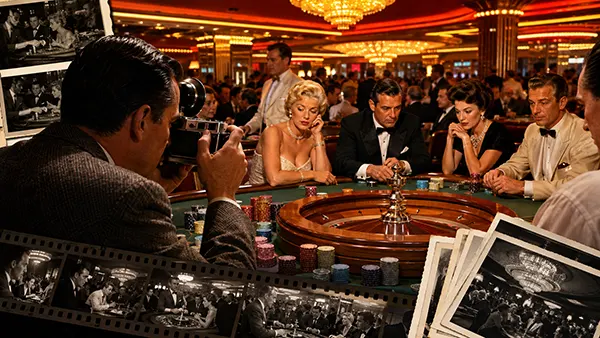
One of the most striking early examples is Henri Cartier-Bresson’s Las Vegas work from 1947. A surviving photograph commonly identified as Las Vegas (3 people at gambling wheel) places three players around a gaming table, with the wheel occupying much of the foreground. There is no attempt to turn the scene into a celebration of wealth. The strongest elements are the players themselves: their downward gazes, their physical closeness to the table and the pause before the result becomes known. Cartier-Bresson photographed Las Vegas at a particularly revealing moment. Nevada had restored legal gambling in 1931, but the city of 1947 was still far removed from the enormous resort district familiar today. The Flamingo was only entering its early years, Fremont Street remained a central focus of casino activity, and much of the visual identity later associated with Las Vegas was still being formed. The photograph therefore captures gambling before the city’s casino imagery became completely inseparable from large-scale spectacle.
Cartier-Bresson’s approach matters because he was interested in human behaviour rather than in providing a catalogue of casino attractions. His photographs often depend on a short-lived relationship between gesture, expression and surroundings. His famous book Images à la Sauvette, published in France in 1952 and known in its American edition as The Decisive Moment, later gave a name to this way of thinking about photography. In the Las Vegas gaming scene, the important moment is not necessarily the instant when somebody wins or loses. Instead, it is the period of uncertainty immediately before the outcome. The money has already been committed, the wheel is moving or about to move, and the people in the frame can do little except watch. That makes the photograph understandable even to somebody with no interest in casino games. Its real subject is anticipation, one of the most basic emotions created whenever a person willingly gives control of an outcome to chance.
The photograph also demonstrates how a casino can create unusually compressed social scenes. People who may have no connection outside the room stand or sit within centimetres of one another, following the same wheel while hoping for different results. Chips replace ordinary currency, formal rules control every action, and emotions that might normally remain private become visible in public. A photographer does not need to know the value of every wager to record these relationships. A hand resting near a stack of chips, a player leaning closer to the table or somebody watching another person’s bet can say more about the experience than a picture filled with casino branding. That distinction remains important when viewing historic gambling photography today. The most informative photographs are often not those showing the largest rooms or brightest signs, but those that preserve small pieces of behaviour that would otherwise disappear: where people looked, how closely they gathered around a table and how their bodies responded while they waited for an uncertain result.
Henri Cartier-Bresson and the Quiet Tension Around the Gaming Table
Cartier-Bresson’s Las Vegas photograph is particularly valuable because the people do not appear to be performing for the camera. The central woman is absorbed by the table rather than by the photographer, while the surrounding figures direct their attention towards the game. This creates a very different impression from a posed casino publicity picture. Instead of being told that gambling is glamorous, the viewer is allowed to observe how it occupies people’s attention. The distinction is subtle but important. A photograph made for advertising normally has a clear message to communicate, whereas an observational photograph can leave questions unresolved. We do not know whether these players are regular visitors or tourists, whether their wagers are large or small, or what happens after the shutter is released. The absence of that information is not a weakness. It keeps the photograph focused on a brief human situation rather than turning three individuals into illustrations of a predetermined story about gambling.
There is also an interesting contrast between the visual order of the photograph and the uncertainty of the activity it records. The roulette wheel is circular and precise. Chips are arranged according to rules. The table has fixed betting areas, and the game follows a known sequence. Yet the result remains unpredictable for the people placing the wagers. That opposition between order and chance appears repeatedly in strong casino photography. The room may be carefully designed, the dealer may follow a strict procedure and every object may have a particular place, but none of those things gives the player control over a random outcome. Cartier-Bresson did not need technical explanations of probability to make this visible. By concentrating attention on faces, hands and the wheel itself, the photograph turns an abstract idea about chance into something physical. The viewer can understand that the people are waiting for something important to them even without knowing the size or location of their individual bets.
The continuing presence of this Las Vegas work in major photographic collections also separates it from the countless casino images produced only for immediate commercial use. The International Center of Photography catalogues a Cartier-Bresson photograph titled Las Vegas from 1947, while another vintage 1947 print depicting three people at a gambling wheel has appeared through Christie’s. These records give the image a documented place within Cartier-Bresson’s wider American work rather than treating it as an isolated curiosity. That wider context matters. In the same period, he photographed writers, streets, political events and ordinary social life. A gambling table was therefore one more place where people revealed themselves through gesture and attention. Seen this way, the casino becomes less exotic. It is a social environment in which familiar emotions — expectation, caution, curiosity and disappointment — happen to be intensified by the presence of money and chance.
Robert Frank, LIFE and a Less Romantic Picture of Gambling
By the mid-1950s, photographers were recording gambling at exactly the moment when Las Vegas was becoming a national symbol. Robert Frank approached the subject with a markedly different visual language from the polished pictures commonly associated with the city. The National Gallery of Art holds his 1955 photograph Gambling—Nevada, and casino imagery also forms part of the visual sequence associated with his landmark book The Americans. In Frank’s work, gambling fits into a much broader examination of American life rather than standing alone as colourful entertainment. Cars, cafés, roads, political symbols, jukeboxes, diners and people waiting or travelling all contribute to the same picture of the country. A casino player therefore becomes part of a larger story about hope, money, movement and social distance. This approach weakened the boundary between the supposedly extraordinary environment of gambling and ordinary post-war American experience.
Frank was not the only important photographer pointing a camera towards Nevada’s gaming rooms. LIFE photographers had already produced substantial visual records of Las Vegas. Peter Stackpole photographed gambling there in 1942, while Loomis Dean created one of the best-known photographic records of the city’s rapid expansion in 1955. Dean’s assignment is especially useful because it includes scenes that resist the usual memory of permanently crowded, prosperous casinos. LIFE preserved photographs of croupiers standing behind quiet roulette tables at the recently opened Dunes, where business was lighter than expected only weeks after opening. Other frames show casino interiors, construction, hotels, pools and the desert city around them. Together they provide a reminder that the famous mid-century Las Vegas boom was not a single uninterrupted success story. New properties involved enormous financial bets of their own, visitor numbers could disappoint expectations, and the city’s future was not as obvious to people living through the period as it can appear in retrospect.
These photographers also show why the identity of the person behind the camera matters. A casino can look entirely different depending on whether the photographer is working as an independent observer, completing a magazine assignment or producing publicity for a resort. The objects in the room may remain the same — tables, cards, dice, chips and lights — but the visual priorities change. A publicity image may concentrate on full tables, fashionable guests and impressive interiors. A magazine photographer can choose an empty corner, a tired employee or an awkward pause. A documentary photographer may ignore the architecture almost completely and concentrate on one face. None of these approaches automatically tells the whole truth. Each records a selected part of what was present. For that reason, historic casino photography becomes far more useful when images from different photographers and different types of commissions are compared rather than treated as interchangeable illustrations of the past.
What Photographers Found Beyond Winning and Losing
Looking closely at these photographs changes the meaning of a casino floor. Popular descriptions tend to reduce gambling to two outcomes — winning and losing — but photographs preserve everything that happens between them. People wait for dealers, calculate what to do next, watch strangers, talk to companions, order drinks, move between tables or simply sit without playing. Employees perform repetitive work while surrounded by other people’s excitement. Dealers organise chips, control the pace of a game and maintain professional composure regardless of the result. A photograph can also record the physical distance between spectators and players, the different ways men and women dressed for an evening out, and the degree to which casino entertainment was integrated with restaurants, bars, hotel rooms and live shows. These details are historically useful precisely because they were often too ordinary to receive much attention in written accounts at the time.
The contrast between excitement and boredom is particularly revealing. Casinos are designed around repeated events, and repetition inevitably produces quiet intervals. A roulette wheel has to be reset. Cards have to be dealt again. Chips have to be collected and paid. Players pause before deciding whether to continue. Photographers such as Frank and Dean were able to use these intervals to undermine the idea that every second inside a casino was dramatic. In some photographs, people appear intensely focused; in others, staff wait for customers or guests look detached from the activity around them. Both states belong to the same environment. This is one reason historic photographs can be more informative than idealised illustrations created later. They preserve contradictions. Las Vegas can appear crowded and lonely, luxurious and unfinished, confident and financially uncertain, sometimes within photographs made during the same year.
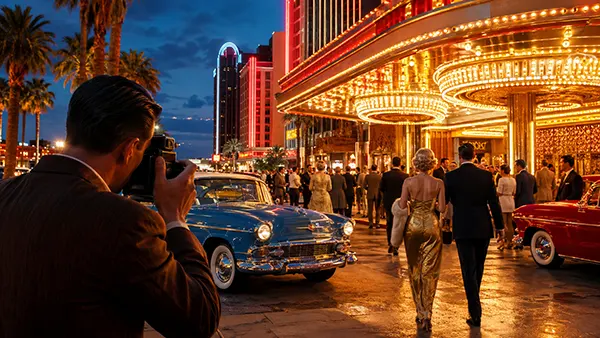
Photography also makes visible how much gambling depends on spaces built to guide attention. Early casino interiors were generally smaller and less elaborate than the vast rooms that became common in later decades, yet many familiar principles were already present. Gaming tables created natural circles of spectators, lighting helped separate active areas from the surrounding room, and dealers occupied clearly defined positions. Exterior photography added another layer. Fremont Street signs and later the large roadside signs of the Strip competed for attention long before a visitor entered a casino. When these exterior and interior images are viewed together, gambling appears as part of a continuous visual experience rather than a single activity at a table. The visitor first encounters promises through architecture and signs, then enters a controlled interior where the visual focus shifts towards games, people and money. Photographers documented that transition even when it was not the explicit subject of their assignments.
Archival Las Vegas and the Construction of a Casino Image
The photographic history of Las Vegas is unusually extensive because the city did not merely attract photographers; local organisations deliberately photographed it on a vast scale. The present LVCVA Archive dates its collection to 1947 and states that it contains about 7.5 million images as well as nearly half a million moving images. Its origins are important for understanding what those pictures represent. The collection grew from efforts by the Las Vegas Chamber of Commerce to promote Southern Nevada and increase tourism. Photographers recorded hotels, performers, celebrities, sporting events, swimming pools, streets and casino life because images were essential to selling an idea of Las Vegas to audiences elsewhere. The result is an extraordinary historical record, but it is also a record created with a purpose. Many photographs were intended to make the destination attractive. Their documentary value is considerable, yet their promotional origin should remain part of the way they are interpreted.
University archives provide another major source. UNLV Special Collections and Archives holds extensive material connected with gaming, including photographs, manuscripts, resort records, promotional material and oral histories. Its Sands Hotel Photograph Collection, covering approximately 1952 to 1980, includes entertainers, casino patrons, employees, events and hotel facilities. Separate Sands public-relations records preserve photographs alongside press releases, brochures, clippings and internal material from advertising and promotion work. This combination is particularly useful because it allows researchers to study not only a finished photograph but also the business environment in which images were produced and distributed. A photograph of a celebrity at a gaming table, for example, can be read very differently when it is understood as part of a publicity campaign rather than spontaneous documentation. The archive does not make the image less valuable; it gives the viewer more information about why the image exists.
The archival record also extends well beyond the most familiar pictures of the 1950s and 1960s. Collections contain material relating to casinos that disappeared, buildings that were remodelled beyond recognition, entertainment programmes that lasted only a season and working areas rarely remembered by visitors. UNLV continues to draw attention to this visual history. In 2026, the university highlighted the Robert Scott Hooper Photograph Collection, noting how more than four decades of his work helped shape impressions of Las Vegas through magazines, newspapers, playbills, billboards, postcards and other uses. Such collections show that the visual identity of the city was not created by one famous photographer or one celebrated decade. It accumulated through millions of photographs made for journalism, tourism, commercial clients, private collections and historical documentation. The familiar image of Las Vegas is therefore not a single picture but a long process of selection and repetition.
How Historic Casino Photographs Can Be Read in 2026
A useful way to read an old casino photograph is to begin with information outside the frame. The date, photographer, original client and archival collection can substantially change its meaning. A 1950s image commissioned by a hotel publicity office was created under different conditions from a photograph made for an independent magazine assignment. A press photograph distributed internationally may have been selected because it supported a particular story about prosperity, celebrity or novelty. An unused negative from the same assignment may show something much less polished. Even the caption deserves attention because historical captions sometimes contain assumptions or promotional language that should not simply be repeated as fact today. Archives such as those maintained by UNLV and the LVCVA are valuable partly because catalogue records help reconnect images with dates, collections and organisations that can otherwise disappear when old photographs are copied across the internet without context.
The second step is to consider what the photographer included and what remains outside the frame. A crowded table may suggest a busy casino, but it does not prove that the entire property was full. A photograph of a celebrity playing cards may document a real visit while also functioning as organised publicity. A glamorous exterior at night tells us a great deal about signage and architecture but almost nothing about the financial experience of the people inside. The same caution applies in the opposite direction: one tired player cannot represent every visitor. Strong historical interpretation comes from comparing images rather than forcing a single photograph to carry a complete explanation. Casino photographs become especially informative when interior scenes are considered alongside street photographs, hotel records, contemporary journalism and images made by photographers with different reasons for being there.
Finally, gambling photography is most useful when the people in the pictures remain people rather than symbols of success or failure. A camera cannot tell us whether somebody developed a gambling problem, whether a particular wager was affordable or whether a person photographed smiling eventually left with more or less money. Claims of that kind require evidence that the image alone cannot provide. What photography can do exceptionally well is preserve behaviour, atmosphere and place. Cartier-Bresson gives us the concentration around a gaming wheel in 1947. Robert Frank places gambling within a more complicated picture of American life. LIFE photographers record both the confidence and uncertainty of the 1950s casino boom. Las Vegas archives preserve the deliberate construction of the city’s public image alongside countless details that have outlived the buildings and businesses themselves. Viewed together in 2026, these photographs turn gambling history into social history: a record of how people looked, waited, worked, advertised, entertained themselves and responded to chance in places built around it.