
Enamel, Miniature and Cards: How Jewellers Transferred Gaming Motifs into Small Decorative Forms
Card symbols, roulette sectors and gaming scenes have long moved beyond tables and into the language of decorative arts. By the late 19th century and continuing into 2026, jewellers and artisans have been refining ways to translate these motifs into compact objects such as rings, pendants, snuff boxes and cufflinks. The key challenge has never been the idea itself, but the precision of execution: how to render recognisable gaming symbols within a few millimetres without losing clarity, depth or aesthetic balance.
Techniques That Best Capture Suits, Cards and Roulette Patterns
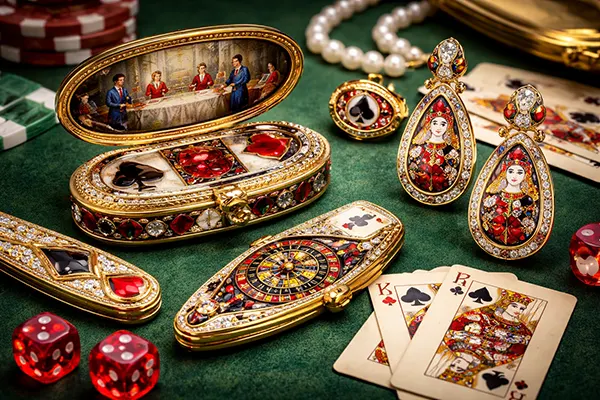
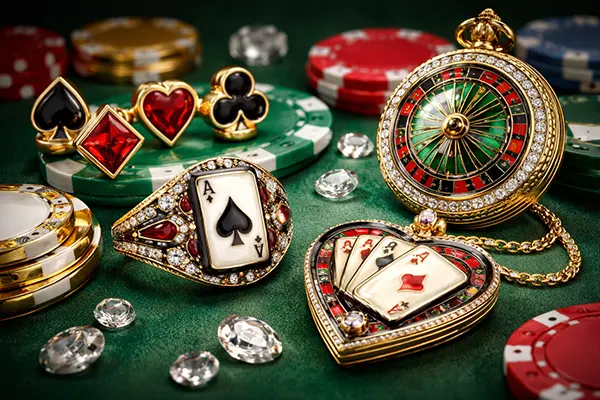
Among traditional methods, enamel remains one of the most reliable ways to reproduce the strong colour contrast required for card suits. Cloisonné enamel allows craftsmen to separate colours using fine metal wires, making it ideal for hearts, diamonds, spades and clubs. Guilloché enamel, often seen in high-end watch dials and jewellery, adds a patterned metallic base beneath translucent enamel, creating depth that mimics the layered design of premium playing cards.
Miniature painting, particularly on ivory substitutes or metal surfaces, enables detailed narrative scenes. This technique has been used historically to depict entire card tables or stylised figures such as kings and queens from decks. Modern artisans often combine this with protective coatings to ensure durability, as miniature painting is more vulnerable to wear than enamel or engraving.
Engraving and micro-engraving remain essential for monochrome designs, especially for roulette layouts and numeric sequences. Laser-assisted engraving, now widely used by specialised workshops, allows for precision down to fractions of a millimetre. This is particularly useful when reproducing roulette wheels or betting grids where symmetry and spacing are critical.
Material Choices and Their Influence on Visual Clarity
The choice of base material directly affects how well gaming motifs are perceived. Gold, especially yellow gold, enhances the warmth of enamel colours, while white gold or platinum provides a neutral background that increases contrast for black and red elements. This becomes important when working with traditional suit colours that rely on sharp visual separation.
Hard stones such as onyx, lapis lazuli and mother-of-pearl are often used as inlays. Onyx, for example, provides a deep black surface ideal for engraved spades or roulette numbers. Mother-of-pearl introduces a subtle iridescence, which can soften the rigid geometry of gaming symbols and make the piece feel more refined.
Modern materials, including ceramics and high-performance composites, have entered the field as of 2026. These allow for lighter objects with high resistance to scratches, making them suitable for everyday jewellery that still carries detailed gaming imagery without rapid degradation.
Why Small Decorative Forms Suit Gaming Symbolism
Gaming symbols are inherently compact and geometric. A heart, diamond or spade is recognisable even at a very small scale, which makes them naturally adaptable to jewellery and miniature objects. Unlike complex figurative art, these symbols retain their identity even when simplified, allowing artisans to work within strict spatial limits.
Another factor is repetition. Card suits and roulette segments rely on repeated patterns, which align well with decorative design principles. Rings, bracelets and watch bezels benefit from this repetition, creating rhythm and coherence without requiring large surfaces.
There is also a cultural aspect. Small objects such as pendants or cufflinks often function as personal symbols rather than public statements. Gaming motifs, when executed with restraint, become subtle references rather than overt themes. This balance is particularly relevant in contemporary jewellery, where understatement is often preferred over direct representation.
Scale, Proportion and the Role of Detail
Working at a reduced scale forces a shift in priorities. Not every detail from a playing card can be transferred into jewellery. Skilled jewellers focus on the most recognisable elements: suit shapes, corner indices or simplified portraits. This selective approach ensures that the piece remains legible without appearing cluttered.
Proportion becomes critical when combining multiple techniques. For instance, an engraved outline paired with enamel filling must maintain consistent thickness; otherwise, the design loses balance. Even slight deviations are noticeable at small scales, which is why high-end workshops rely on magnification tools and precision instruments.
In 2026, digital modelling has become a standard preparatory step. Designers create 3D models before production, allowing them to test proportions and visual clarity. However, the final quality still depends on manual finishing, as machine precision alone cannot replicate the subtle variations that give a piece character.
How to Distinguish Craftsmanship from Thematic Decoration
Not every object featuring card motifs qualifies as high-quality craftsmanship. One of the primary indicators is the depth of technique. Surface printing or basic stamping may produce a decorative effect, but it lacks the durability and refinement of enamel, engraving or inlay work. Over time, printed designs tend to fade, while properly executed techniques retain their integrity.
Another factor is edge definition. In well-crafted pieces, lines are clean and consistent, even under magnification. Blurred edges or uneven colour distribution often indicate mass production rather than skilled workmanship. This is particularly evident in enamel pieces, where improper firing can lead to bubbles or inconsistencies.
Weight and finishing also reveal much about quality. Handmade or carefully crafted items usually have balanced weight and smooth transitions between materials. Rough edges, visible seams or inconsistent polishing suggest shortcuts in production, which affect both aesthetics and longevity.
Practical Criteria for Evaluating Jewellery with Gaming Motifs
A close inspection of the surface is the first step. High-quality enamel should appear smooth and glass-like, without cracks or dull patches. Engraving should be sharp and evenly spaced, with no signs of tool slipping or irregular depth.
Examining the reverse side of the piece can also provide insights. Reputable jewellers often finish even the hidden parts, ensuring there are no rough areas or unfinished metal. This attention to detail reflects the overall standard of the workshop.
Finally, provenance and technique disclosure matter. Established ateliers typically specify the methods used, such as hand engraving or guilloché enamel. This transparency helps distinguish authentic craftsmanship from purely decorative items that rely on visual imitation rather than technical execution.