
Jewellery Made from Broken Glass, Asphalt and Metal: The Experimental Art of Bernhard Schobinger
A broken bottle, a fragment of road surface or a rusted nail would rarely be considered suitable material for fine jewellery. For Swiss artist Bernhard Schobinger, however, such objects carry stories that precious metals and carefully cut gemstones cannot always express. Born in Zurich in 1946, Schobinger has spent more than five decades questioning conventional ideas of beauty, craftsmanship and material value. His necklaces, rings and bracelets combine discarded industrial objects with gold, crystals and other traditional jewellery materials. Influenced by punk culture, experimental art and the changing European cultural landscape, his creations often appear deliberately uncomfortable or even dangerous. Yet behind their unsettling appearance lies the precision of a trained goldsmith. By 2026, Schobinger’s work had become the subject of a major American museum exhibition, confirming his importance in the history of contemporary jewellery.
How Bernhard Schobinger Changed the Meaning of Jewellery
Bernhard Schobinger’s artistic development began with a conventional education in jewellery making. He studied at the Zurich School of Applied Arts and trained as a goldsmith during the 1960s, acquiring the technical knowledge required to work with precious metals and produce carefully constructed objects. In 1968, he established his independent workshop in Richterswil, near Lake Zurich. His early creations reflected an interest in geometric forms, structural balance and the relationship between individual components. These concerns connected his work with Constructivism and Concrete Art, movements that emphasised clear compositions and the independent qualities of shapes and materials. Even before introducing discarded objects into his jewellery, Schobinger was interested in moving beyond familiar decorative conventions.
A significant change occurred during the late 1970s, when Schobinger encountered the emerging punk movement. Travelling between Zurich, London, Berlin and New York, he experienced an artistic environment in which established standards were openly challenged. Punk musicians and their audiences frequently used torn clothing, safety pins, chains and improvised accessories to communicate independence and opposition to authority. Schobinger recognised a similar expressive potential in jewellery. Rather than treating ornament as a demonstration of wealth or social position, he began creating objects that communicated tension, disorder and personal experience. His materials increasingly came from streets, demolished buildings, concerts and other places associated with everyday urban life.
This transformation was particularly important because jewellery traditionally depended on a hierarchy of materials. Gold and diamonds occupied prestigious positions, while rusted iron, broken glass and industrial fragments were generally regarded as worthless. Schobinger refused to accept that distinction as an artistic limitation. He could place a valuable gemstone beside an ordinary piece of wire without allowing either material to dominate the composition. The resulting objects challenged viewers to reconsider why certain substances were admired and others discarded. Their value came not simply from material cost but from the artist’s decisions, the history of the objects and the relationships created between apparently incompatible elements.
From Traditional Goldsmithing to Punk-Inspired Art
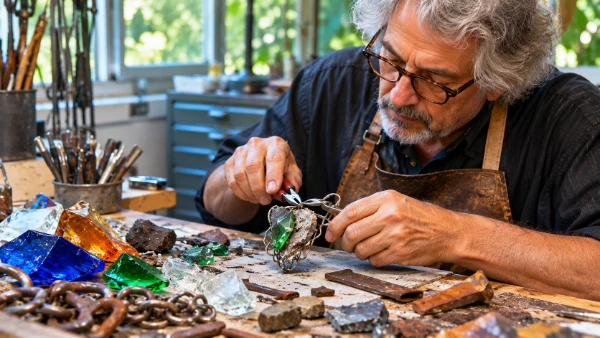
Schobinger’s unconventional approach should not be mistaken for a rejection of craftsmanship. His training remained essential as his materials became more difficult to handle. Broken glass, irregular metal fragments and objects originally manufactured for completely different purposes do not naturally fit the human body. Turning them into jewellery requires careful consideration of balance, connections, weight and structural stability. Schobinger uses established jewellery-making knowledge to construct pieces whose appearance may suggest spontaneity or destruction. This contrast between technical control and visual disorder is one of the defining characteristics of his work. The object can look improvised while actually involving considerable artistic judgement.
Several artistic traditions contributed to this approach. Dada encouraged the use of ordinary objects in unexpected artistic contexts, while Surrealism demonstrated how familiar things could acquire strange associations through unusual combinations. Arte Povera, which emerged in Italy during the 1960s, questioned conventional distinctions between prestigious art materials and substances associated with daily existence. Schobinger’s work shares important characteristics with these movements, although it developed its own identity through jewellery. Unlike a sculpture intended solely for exhibition, a necklace or ring has an immediate relationship with the human body. Its meaning changes when someone wears it, bringing questions of comfort, vulnerability and personal expression into the experience.
His artistic independence also reflects the cultural circumstances surrounding his career. The Cold War, post-war European history, changing consumer habits and the rebellious music of the late twentieth century influenced the objects and imagery available to him. A fragment collected near the Berlin Wall, for example, carries associations that differ substantially from those of an ordinary decorative bead. Such materials allow jewellery to communicate historical and social experiences without relying on written statements. Schobinger has continued exploring these possibilities over successive decades, producing work that connects the precision of Swiss craftsmanship with the experimental attitudes of contemporary art.
Broken Glass, Asphalt and Metal as Artistic Materials
One of the most distinctive aspects of Schobinger’s practice is the way he collects materials. Instead of beginning every creation with newly purchased supplies, he often searches for objects that already possess a history. His sources have included abandoned urban spaces, damaged buildings, concert venues and the waters of Lake Zurich. Among his discoveries are broken bottles, fishing hooks, old door handles and industrial metal components. Some objects remain in his workshop for years before becoming part of a finished piece. This process resembles collecting historical evidence: each fragment records something about its original environment, previous use or eventual abandonment.
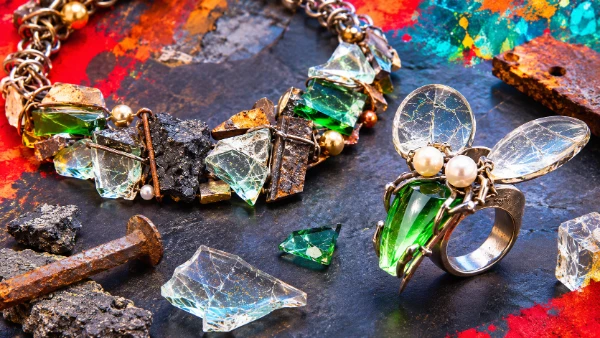
Glass occupies a particularly important position in his jewellery because it combines visual delicacy with an unmistakable suggestion of danger. Its transparent surfaces can reflect light in ways associated with precious stones, but its fractured edges reveal a history of breakage. Schobinger has produced rings and necklaces incorporating fragments from bottles and other glass objects, sometimes combining them with gold or valuable beads. Rather than concealing every indication of damage, he often makes the broken appearance central to the design. The material’s earlier identity remains recognisable, encouraging viewers to consider the transformation from discarded object to artistic ornament.
Metal provides another source of expressive possibilities. Old nails, wire, damaged tools and pieces of industrial equipment possess textures and shapes that differ from polished jewellery components. Rust and signs of wear can suggest age, exposure and physical labour, while blades and pointed elements introduce associations with danger. Asphalt adds an even more unexpected material: a substance normally connected with roads and heavy traffic becomes part of an object associated with personal adornment. When these materials appear alongside gold, pearls or crystals, their contrasting histories become essential to the composition. Schobinger does not merely disguise waste as luxury; he uses the differences between materials to question what makes an object valuable.
Three Remarkable Works That Reveal His Artistic Method
The necklace NYC 1980, created in 1980, provides a direct example of Schobinger’s use of urban materials. It incorporates metal, asphalt and wire, including fragments associated with a deteriorating section of West Broadway in New York. The work has a compact, almost architectural arrangement, with irregular components connected by thin wire. Its rough surfaces preserve a connection with the street from which the materials originated. Measuring approximately 19.1 centimetres in overall height, the necklace belongs to the collection of the Museum of Fine Arts, Houston. It demonstrates how an ordinary section of urban infrastructure can become a personal object carrying memories of a particular place and period.
Another important creation is Shards from Moritzplatz Berlin, made between 1983 and 1984. This necklace combines antique crystal beads with fragments of German Coca-Cola bottles, television bulbs, silver and steel wire. Schobinger collected the broken glass in Berlin’s Moritzplatz area, which was closely associated with alternative artistic communities and punk culture near the Berlin Wall. The juxtaposition of traditional crystal beads and damaged consumer objects creates a deliberate contrast between refinement and destruction. It also connects historical European decorative traditions with the commercial products and political atmosphere of the late twentieth century. The work is preserved in the Museum of Fine Arts, Houston, where its materials and historical associations are documented.
Schobinger’s Glassfly ring, made in 2009, demonstrates a different application of recovered glass. The ring incorporates a broken green glass bottleneck, found spectacle lenses and two Akoya pearls. Arranged together, these elements resemble an insect, with the pearls suggesting eyes and the lenses forming wing-like shapes. The Corning Museum of Glass records the work as a combination of broken, ground and assembled components. Its appearance is playful, but its materials retain the unexpected character associated with Schobinger’s jewellery. The ring demonstrates that discarded glass can support figurative imagery as well as abstract compositions. It also reveals the artist’s ability to combine humour, transformation and technical skill within a relatively small object.
The Artistic Legacy of Bernhard Schobinger in 2026
Over the course of his career, Schobinger has helped establish jewellery as an independent form of artistic expression rather than a category defined primarily by fashion or luxury. His creations belong to a field commonly described as contemporary art jewellery, where conceptual meaning can be as important as appearance or commercial value. Artists working in this field may use unusual materials, challenge expectations of wearability or question the social functions of ornament. Schobinger contributed to this development by showing that objects associated with destruction, waste and industrial life could communicate complex ideas through their relationship with the body. His influence extends beyond the specific materials he uses to the freedom with which jewellery can be conceived.
International recognition has developed through exhibitions, specialist publications and museum acquisitions. His work appears in significant collections, including the Victoria and Albert Museum in London, the Museum of Fine Arts, Houston, and institutions in continental Europe, Australia and the United States. In 1998, he received the Françoise van den Bosch Award, an important distinction in contemporary jewellery. His involvement with major museums also demonstrates how attitudes towards unconventional jewellery have changed. Objects once considered too experimental for traditional jewellery collections are now examined for their artistic, cultural and historical importance.
Schobinger’s career has remained active well into the twenty-first century. In 2015, the Corning Museum of Glass selected him for its Rakow Commission, recognising his experimental use of glass. His commissioned work, Tantric Object, incorporated the bases of old Swiss poison bottles shaped like skulls and decorated with gold lacquer. The German word Gift, meaning poison, creates an additional contrast with the English meaning of the same word. Later exhibitions continued to examine the relationship between his jewellery and broader artistic practice. The 2024 exhibition B.S. Kosmos – 50 Years of Creation at Kunsthalle Friart in Fribourg presented an extensive view of his creative development, demonstrating the breadth of his work beyond a single material or period.
Why His Jewellery Remains Relevant to Contemporary Art
A major milestone arrived in September 2026 with the opening of Going Underground: The Jewels of Bernhard Schobinger at the Museum of Fine Arts, Houston. Running from 3 September 2026 to 3 January 2027, the exhibition marked the first American museum exhibition devoted to his work. It brought together 53 significant pieces of experimental jewellery and selected sculptures spanning his career from 1968 onwards. Curated by Cindi Strauss and Elizabeth Essner, the presentation examined his artistic development through the influence of punk culture, historical events and different artistic traditions. By bringing together works from separate decades, the exhibition allowed visitors to trace both the continuity of his ideas and the variety of objects he has transformed.
His work also raises questions that remain relevant to contemporary discussions of material consumption. The use of discarded objects can reduce dependence on newly manufactured decorative components, but Schobinger’s practice should not be reduced to a simple statement about recycling. His primary artistic interest lies in the meanings already carried by materials. A broken bottle can represent a specific cultural encounter, while a nail may suggest construction, labour or violence. The identity of each object contributes to the finished jewellery. This approach differs from decorative upcycling, where the principal objective is often to make waste visually attractive or practically useful. Schobinger allows the uncomfortable history and appearance of his materials to remain visible.
Perhaps the most enduring contribution of Bernhard Schobinger is his demonstration that jewellery can be simultaneously intimate, provocative and historically meaningful. A conventional necklace may communicate elegance or status, but his pieces can invite questions about consumer culture, political history, physical vulnerability and the value attached to ordinary possessions. Their rough materials and unconventional forms are supported by decades of technical experience and artistic experimentation. The broken glass, asphalt and metal are therefore not simply unusual substitutes for gemstones. They are essential parts of a visual language that turns traces of everyday life into objects of cultural memory. His career shows how jewellery can challenge familiar assumptions while retaining a powerful connection with the person who wears it.