
Lab-Grown Diamonds in 2026: How They Are Identified and What the Certificate Shows
Lab-grown diamonds are no longer a specialist product found only in a small part of the jewellery market. In 2026, they are widely used in engagement rings, earrings, pendants and other pieces, yet many buyers still have the same practical questions: are they genuine diamonds, can they be recognised by sight, and what does the accompanying certificate actually prove? The clearest answer begins with terminology. A laboratory-grown diamond has the crystal structure and principal physical and optical properties of a natural diamond, but it was produced by a controlled manufacturing process rather than formed underground. Its origin cannot usually be confirmed with the naked eye, so a reliable grading report and professional testing remain central to an informed purchase.
What Makes a Lab-Grown Diamond Different from a Natural Diamond
A lab-grown diamond is made from carbon arranged in the same diamond crystal structure found in a natural stone. This is why it can have the same hardness, brilliance, fire and transparent appearance. It is not the same material as cubic zirconia, glass or moissanite, which are diamond simulants with different compositions and properties. The term “laboratory-grown” describes the diamond’s origin, not an imitation. For a buyer, this distinction matters because a visual resemblance alone does not make every clear stone a diamond, while a manufactured origin does not make a laboratory-grown diamond a fake.
Most gem-quality laboratory-grown diamonds are produced by one of two methods: High Pressure High Temperature, usually shortened to HPHT, or Chemical Vapour Deposition, known as CVD. HPHT recreates the pressure and heat conditions under which diamond can crystallise, while CVD builds diamond in layers from a carbon-rich gas inside a controlled chamber. Both processes can produce material suitable for fine jewellery. After growth, some stones undergo additional treatment to improve or alter their colour, and a reputable laboratory may record the growth method and any detected post-growth treatment in its report.
The practical difference between natural and laboratory-grown diamonds is their growth history. Natural diamonds formed within the Earth over geological time, whereas laboratory-grown diamonds develop in manufactured equipment over a much shorter period. That difference leaves microscopic and atomic-scale features that trained laboratories can detect. It does not normally create an obvious mark visible to a shopper. Two round brilliant diamonds with similar colour, clarity, cut and carat weight can look extremely alike even when one is natural and the other was grown by HPHT or CVD.
Why Home Tests and Visual Inspection Are Not Enough
A standard handheld diamond tester is not a dependable origin test. Such a device may help separate diamond from certain simulants by measuring thermal or electrical behaviour, but natural and laboratory-grown diamonds share many of the properties being measured. A positive “diamond” result therefore does not answer the natural-versus-laboratory-grown question. Older testing devices may also produce uncertain results with some stones, so the seller’s description and an independent report should carry more weight than a quick counter-top demonstration.
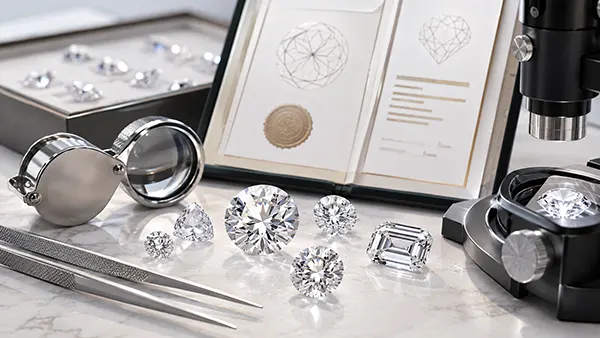
A jeweller’s loupe can reveal inclusions, surface marks and cutting details, but it rarely provides conclusive proof of origin by itself. Some HPHT stones may contain metallic-looking inclusions, while some CVD stones show fine growth lines or other internal features. Natural diamonds also contain varied inclusions, and modern production can create laboratory-grown stones with very clean appearances. One clue may suggest that further testing is needed, but a responsible gemmologist does not identify origin from a single inclusion or visual pattern.
A laser inscription on the girdle is useful, especially when it states “Laboratory-Grown” and carries a report number. It should still be treated as one part of the verification process rather than the only evidence. The number must match the laboratory’s online record, while the carat weight, measurements, shape and other details should agree with the stone being offered. Inscriptions are extremely small and usually require magnification, and a mounted diamond may be difficult to inspect from every angle. For higher-value purchases, verification by an independent jeweller or gemmologist adds sensible protection.
How Gemmological Laboratories Identify Lab-Grown Diamonds
Professional identification begins without assuming that the submitted stone is natural, laboratory-grown or even diamond. The laboratory first confirms the material and then screens it for features associated with different growth histories. This matters because a clear faceted stone could be a natural diamond, a laboratory-grown diamond, a treated diamond or a simulant. Established laboratories use several tests together, since no simple visual check is reliable for every diamond sold in 2026.
Specialised imaging equipment examines how the diamond reacts to ultraviolet light. Natural, HPHT-grown and CVD-grown diamonds can display different fluorescence colours, intensities and growth patterns because their crystals formed under different conditions. An HPHT crystal may show sector-related patterns linked to the directions in which it grew, while a CVD crystal may show layered or banded growth. These patterns are often clear to trained staff using suitable instruments, but they are not the sort of effect a buyer can reliably judge under ordinary shop lighting.
Spectroscopic testing provides another major part of the identification. In straightforward terms, the instrument measures how the diamond absorbs or emits light at selected wavelengths. The resulting data can reveal very small differences in trace elements, crystal defects and treatment history. Laboratories compare those results with large reference databases and with other observations from microscopy and ultraviolet imaging. The final origin decision is therefore based on a body of consistent evidence, not on one machine producing a simple yes-or-no answer.
What HPHT, CVD and Post-Growth Treatment Clues Mean
HPHT-grown diamonds develop around a small diamond seed in an environment of very high pressure and temperature. Certain metallic flux materials may be used during growth, and tiny remnants can sometimes remain as inclusions. Their crystal structure may also produce characteristic colour zoning, fluorescence or phosphorescence patterns. These signs can support an HPHT identification, but their absence does not prove that a diamond is natural. High-quality HPHT stones may have few visible inclusions, which is why instrumental testing remains necessary.
CVD diamonds grow in successive layers on a thin diamond seed. Earlier CVD material often showed more obvious brown colour, dark particles or layered growth features, but production quality has improved considerably. Modern CVD stones can be colourless or near-colourless and may have high clarity. Laboratories can still identify their growth history through combinations of fluorescence imaging, spectroscopy and microscopic observations. The layered manufacturing process often leaves patterns that are measurable even when the finished diamond looks clean and evenly coloured to the eye.
Post-growth treatment is used on some laboratory-grown diamonds to modify colour after the crystal has formed. For example, a CVD-grown diamond may receive HPHT treatment to reduce an unwanted brown tone, while other processes may create or intensify fancy colours. Treatment does not automatically make a diamond unsuitable for jewellery, but it is material information for the buyer. A detailed report should state the growth process when determined and indicate whether treatment was detected, not detected or considered possible under that laboratory’s reporting policy.
What a Lab-Grown Diamond Certificate Shows in 2026
The document commonly called a certificate is more accurately described as a grading report or quality assessment. Its first task is to identify the submitted stone and state whether it is natural or laboratory-grown. Depending on the laboratory and report type, it may also record the shape, cutting style, exact millimetre measurements, carat weight, colour, clarity, cut grade, polish, symmetry, fluorescence and proportions. Some reports include a clarity plot showing the position of notable internal and external characteristics, while others use a more concise format.
Report formats are not identical across laboratories in 2026. IGI continues to provide full 4Cs grading for laboratory-grown diamonds, including carat weight, colour, clarity and cut, together with descriptive and proportion information where applicable. GIA changed its service for colourless to near-colourless laboratory-grown diamonds on 1 October 2025. Its current quality assessment classifies eligible stones as “Premium” or “Standard” through an overall review of colour, clarity and cut-related workmanship rather than presenting the traditional natural-diamond grading terminology in the same way.
Under the current GIA system, a Premium assessment requires all of the higher thresholds, including D colour, VVS clarity or better, Excellent polish and symmetry, and an Excellent cut grade for a round brilliant. Standard covers qualifying combinations down to E–J colour, VS clarity, Very Good polish, Very Good symmetry, with Good symmetry permitted for fancy shapes, and a Very Good cut grade for round brilliants. A stone below the minimum Standard criteria does not receive this assessment. GIA’s separate reports for laboratory-grown coloured diamonds retain more detailed colour reporting and can include growth type and post-growth treatment information.
How to Check the Report Before Buying
Begin by entering the report number in the issuing laboratory’s official online verification service. The database record should match the document shown by the seller. Compare the description, shape, measurements, carat weight and grading details line by line. A report number that exists online is not enough if it belongs to a different diamond. Small measurement differences may result from rounding, but a different shape, weight or set of dimensions is a clear reason to pause and request an explanation.
Next, ask to see the girdle inscription under magnification when the report states that one is present. The inscription number should match the report, and a GIA-assessed laboratory-grown diamond should also carry wording that identifies it as laboratory-grown. When the stone is already mounted, the setting may cover part of the girdle, so the inscription may not be fully visible. In that situation, matching the available inscription with the report data and arranging an independent check is more reliable than accepting a seller’s verbal assurance.
Finally, understand what the report does not provide. A grading report describes identity and quality characteristics at the time of examination; it is not a monetary valuation, a resale-price promise or a guarantee that the jewellery setting is well made. It also does not by itself prove environmental claims, the source of the electricity used for production or the labour standards of every business in the supply chain. Buyers should therefore assess the laboratory report, seller reputation, written returns policy, warranty, setting quality and total price as separate parts of the same purchasing decision.