
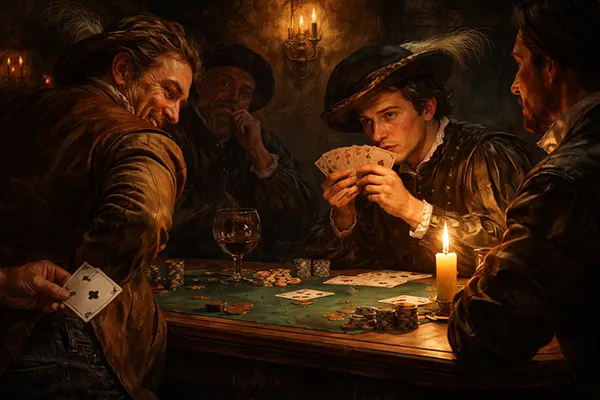
How Artists Depicted Cheating at the Card Table: From Genre Painting to Modern Interpretations
Scenes of deception at the card table have long attracted artists, not merely for their dramatic tension but for what they reveal about human behaviour. From the quiet tension of a concealed card to the calculated glance between players, these moments capture more than gambling—they expose morality, power, and psychology. Across centuries, painters and contemporary creators have returned to this theme, refining visual language to portray dishonesty, suspicion, and fragile trust in increasingly nuanced ways.
Early Genre Painting: Subtle Gestures and Moral Allegory
In 17th-century Europe, particularly within Dutch and French genre painting, artists frequently explored everyday life through scenes of leisure, including card games. These compositions were rarely neutral. Painters such as Caravaggio and Georges de La Tour infused their works with moral undertones, presenting cheating not just as an act but as a symbol of vice and human weakness. The act of deception often unfolded quietly, embedded within otherwise calm domestic interiors.
One of the most studied examples is Caravaggio’s “The Cardsharps” (c. 1594), where the narrative unfolds through hands rather than faces. A young player is distracted while another discreetly retrieves a hidden card behind his back. The visual emphasis lies on the gesture—precise, deliberate, and almost theatrical. This focus on hands became a recurring motif in later works, allowing artists to communicate deceit without explicit confrontation.
These paintings also served as warnings. Viewers of the time would have recognised the coded messages: greed leads to downfall, naivety invites exploitation, and appearances deceive. The calm composition often masked a deeper unease, reinforcing the idea that cheating was not merely a trick but a moral failing embedded in society.
Symbolism of Hands, Cards, and Eye Contact
The visual vocabulary of cheating scenes relied heavily on symbolic elements. Hands became the primary vehicle of narrative—hidden behind backs, slipping cards from sleeves, or signalling silently to accomplices. The precision with which artists rendered these gestures demonstrates an understanding of both anatomy and psychological storytelling.
Cards themselves also carried symbolic weight. Certain suits or positions could imply fortune, risk, or manipulation. A card partially revealed might indicate impending betrayal, while a tightly held hand suggested secrecy. These details were never accidental; they guided the viewer’s interpretation of the unfolding drama.
Eye contact—or the deliberate avoidance of it—added another layer. A conspiratorial glance between cheaters contrasted sharply with the oblivious gaze of the victim. This tension between awareness and ignorance created a dynamic composition, where the viewer often became complicit, recognising the deception before the central figure did.
18th–19th Century Evolution: Drama, Social Commentary, and Realism
As artistic styles evolved, so did the portrayal of cheating at the card table. In the 18th and 19th centuries, artists shifted towards more detailed narratives and social commentary. The setting expanded from intimate interiors to bustling taverns and salons, reflecting broader societal contexts. Cheating was no longer just a moral allegory; it became part of a wider exploration of class, power, and human behaviour.
Painters such as William Hogarth used gambling scenes to critique social decay. In his works, cheating was intertwined with excess, addiction, and moral decline. The figures were less idealised and more caricatured, emphasising the consequences of reckless behaviour. This approach made the scenes more accessible and relatable to a wider audience.
Realism further transformed the genre. Artists began to depict players with greater psychological depth, focusing on tension rather than overt action. The moment of cheating might be subtle—barely noticeable—yet charged with anticipation. This shift mirrored broader changes in art, where internal states and emotional nuance became central themes.
Psychological Tension and Narrative Complexity
By the 19th century, the emphasis moved from the act itself to the atmosphere surrounding it. Artists explored the emotional landscape of the players: suspicion, anxiety, overconfidence. The card table became a stage where these internal conflicts played out, often without resolution.
Lighting played a crucial role in enhancing this tension. Dimly lit scenes, inspired by earlier chiaroscuro techniques, highlighted key gestures while leaving other elements in shadow. This selective visibility mirrored the uncertainty inherent in the game—what is seen versus what is hidden.
The viewer’s role also evolved. Rather than being a passive observer, the audience was invited to interpret the scene, to notice clues and piece together the narrative. This interactive quality added depth, making each viewing a process of discovery rather than simple observation.

Modern and Contemporary Interpretations: Reframing Deception
In modern and contemporary art, the depiction of cheating at the card table has moved beyond literal representation. Artists now use the theme as a metaphor for broader issues—trust in institutions, manipulation in society, and the blurred line between chance and control. The card table remains, but its meaning has expanded.
Photographers and digital artists often reinterpret classical compositions, placing them in contemporary settings. A hidden card might become a symbol of information asymmetry, while a cheating gesture could represent systemic imbalance. These reinterpretations maintain visual continuity with historical works while updating their relevance.
Installation and conceptual art have also embraced the theme. Instead of depicting a single moment, artists create immersive environments where viewers experience uncertainty firsthand. The act of cheating is no longer confined to a painted scene; it becomes an experiential concept, challenging perceptions of fairness and transparency.
From Physical Gesture to Conceptual Meaning
Contemporary works often reduce the visual elements to their essence. A single hand, a fragmented deck, or a distorted table can evoke the entire narrative of deception. This minimalism shifts the focus from storytelling to interpretation, allowing multiple meanings to coexist.
The role of the viewer becomes even more central. Without a clear narrative, interpretation depends on personal experience and context. What once was a straightforward depiction of cheating now becomes a reflection on trust, perception, and human behaviour.
Despite these changes, the core theme remains consistent. Whether in a 17th-century painting or a modern installation, the tension between honesty and deception continues to resonate. The card table, with its inherent uncertainty, provides a timeless framework for exploring these ideas.