
Jewellery in Renaissance Female Portraits: What They Reveal About Status and Family Alliances
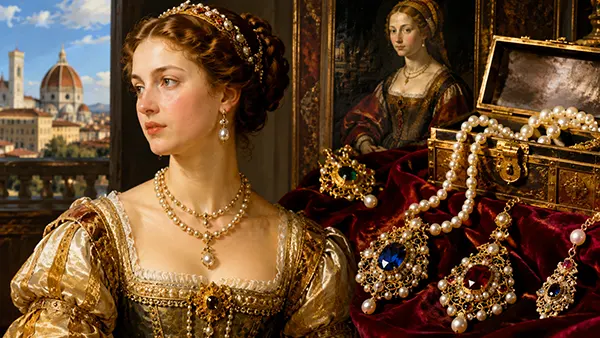
Renaissance portraiture offers far more than a visual record of appearance. Female portraits created between the fifteenth and sixteenth centuries contain valuable information about wealth, family strategies, political relationships and social expectations. Among the most significant visual elements are jewellery pieces, which were carefully selected and deliberately displayed. Necklaces, brooches, rings, pearls and precious gemstones communicated messages that contemporary viewers immediately understood. Today, these objects provide historians and art specialists with important evidence about the lives of noblewomen, marriage arrangements and the distribution of power within European courts.
Jewellery as a Visible Marker of Social Rank
In Renaissance Europe, strict social hierarchies influenced clothing and personal adornment. Expensive jewellery was not merely decorative; it publicly demonstrated access to wealth and elite connections. Goldsmiths worked for royal courts and aristocratic families, creating unique pieces that could rarely be afforded by merchants or ordinary citizens. When artists painted female sitters wearing elaborate necklaces or gem-encrusted ornaments, they were documenting an individual’s place within society.
Pearls appeared frequently in portraits from Italian city-states, Spain, France and England. During the Renaissance, pearls were among the most valuable luxury goods available in Europe. Their rarity and cost made them ideal symbols of prestige. Portraits of women from influential families often featured multiple strands of pearls, pearl earrings and pearl-embroidered garments, reinforcing the family’s economic strength.
Gemstones also carried financial significance. Rubies, sapphires and emeralds were imported through complex trade networks that connected Europe with Asia and the Middle East. Possessing such stones indicated not only wealth but participation in international commerce and political alliances. Their inclusion in portraits functioned as a visual statement of privilege and influence.
The Language of Precious Materials
Different materials communicated different messages to Renaissance audiences. Gold represented permanence, authority and prosperity. Its resistance to corrosion made it an appropriate symbol of enduring family prestige. As a result, gold chains and pendants frequently appeared in portraits commissioned by noble households.
Pearls were associated with purity and virtue, qualities especially valued in aristocratic women. Artists often combined pearl jewellery with modest facial expressions and refined clothing. This visual combination reinforced contemporary ideals of femininity and moral conduct while simultaneously displaying wealth.
Gemstones could carry symbolic meanings linked to religious beliefs and traditional lore. Sapphires were associated with loyalty and wisdom, rubies with power and passion, and emeralds with fertility and renewal. Although interpretations varied between regions, patrons frequently selected jewellery whose symbolism supported the image they wished to project.
Marriage Alliances Reflected Through Jewellery
Many Renaissance female portraits were commissioned in connection with marriage negotiations. Portraits often travelled between courts before a wedding took place, allowing prospective families to evaluate the bride. In such cases, jewellery became an important component of visual communication, highlighting both family wealth and the value of the marriage alliance.
Dowries represented a major element of aristocratic marriage arrangements. Jewellery frequently formed part of these dowries because precious metals and gemstones retained significant monetary value. Portraits displaying luxurious ornaments could therefore serve as evidence of the resources accompanying a marriage contract.
Wedding rings, pendants bearing family emblems and personalised jewellery pieces often appeared in formal portraits. These objects identified connections between powerful dynasties and reminded viewers that marriage was frequently a political and economic arrangement rather than a purely personal relationship.
Heraldry and Family Identity in Portraits
Many jewellery pieces incorporated heraldic motifs. Small details such as coats of arms, family colours or symbolic creatures could be integrated into brooches, pendants and decorative chains. These elements allowed viewers to identify family affiliations immediately.
When two influential families formed a marriage alliance, jewellery could combine symbols from both lineages. Such pieces acted as visual records of political cooperation and dynastic strategy. Portraits preserved these symbols long after the original jewellery may have been altered, sold or lost.
Artists paid careful attention to these details because patrons expected them to be accurately represented. Modern researchers often rely on jewellery depicted in portraits to trace family relationships, inheritance patterns and alliances between noble houses across Europe.
What Modern Research Reveals About Renaissance Jewellery
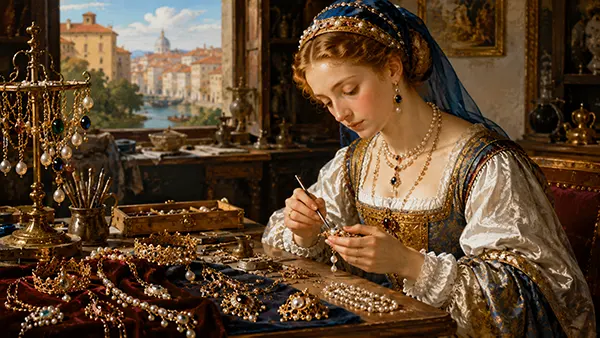
Advances in art history, conservation science and archival research have expanded understanding of jewellery shown in Renaissance portraits. Specialists compare painted objects with surviving inventories, wills and treasury records to identify specific pieces and their owners. This approach helps establish how jewellery circulated among elite families.
Technical examination of paintings has also revealed how carefully artists recorded luxury items. Infrared imaging and high-resolution photography demonstrate that many painters devoted considerable attention to gemstones, metalwork and decorative craftsmanship. Such accuracy suggests that jewellery was regarded as an essential part of a sitter’s identity.
Research conducted throughout the 2020s has increasingly emphasised the role of women as active participants in the ownership, inheritance and transmission of valuable jewellery. Rather than serving solely as passive symbols, noblewomen often controlled significant collections that influenced family finances and social standing.
Why Jewellery Remains Important for Understanding the Renaissance
Jewellery depicted in female portraits provides evidence that written sources alone cannot always supply. Paintings preserve information about fashion trends, material culture and social expectations that might otherwise have disappeared from historical records.
These objects also reveal the interconnected nature of Renaissance society. A single necklace might reflect international trade, family wealth, religious symbolism and marriage strategy simultaneously. Examining jewellery therefore allows historians to understand broader economic and political developments through personal objects.
Today, Renaissance portraits continue to attract attention not only because of their artistic quality but also because they function as visual documents of their era. The jewellery worn by women in these paintings offers a detailed account of status, identity and family alliances, helping modern audiences better understand the complex social world of Renaissance Europe.