
The Greatest Mosaics in the History of Art: How Stone, Glass and Gold Created Images of Eternal Luxury
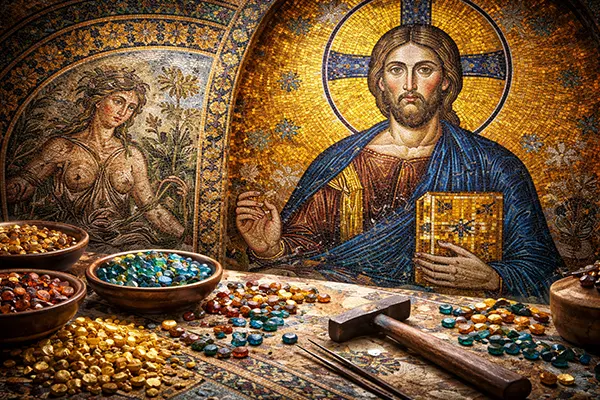
Mosaic art occupies a special place in the history of visual culture. Unlike painting or fresco, mosaics are built from thousands of small pieces of stone, glass or ceramic, carefully arranged to create a unified image. This technique appeared in the ancient world and reached extraordinary refinement in Greek, Roman and Byzantine civilisation. Many of the most impressive mosaics have survived for centuries precisely because of the durability of their materials. Today they are not only historical artefacts but also valuable sources of information about religion, politics, architecture and aesthetics of past societies.
The Origins of Mosaic Art in the Ancient World
The earliest mosaics appeared in Mesopotamia and the eastern Mediterranean around the third millennium BCE. These early works were quite different from later decorative mosaics. Builders used coloured stones, shells and clay cones embedded into walls to create geometric patterns. The aim was both decorative and symbolic, as such ornamentation emphasised the power and wealth of temples and palaces.
The technique developed significantly in ancient Greece. By the fifth and fourth centuries BCE, artists began using small pebbles to construct detailed floor compositions. Greek craftsmen arranged natural stones of different colours to depict mythological scenes, animals and daily life. One of the most famous examples is the pebble mosaic from Pella in northern Greece, created in the fourth century BCE and depicting Dionysus riding a panther.
Roman artists expanded the possibilities of mosaic decoration even further. By the first century BCE, craftsmen were cutting stones into small cubes known as tesserae. This allowed for greater detail and smoother transitions between colours. Roman villas and bath complexes often featured elaborate mosaic floors illustrating hunting scenes, sea creatures, theatre masks or geometric ornament.
Roman Masterpieces That Survived for Millennia
One of the most celebrated Roman mosaics is the Alexander Mosaic discovered in the House of the Faun in Pompeii. Dating from around 100 BCE, it portrays the battle between Alexander the Great and the Persian king Darius III. The work consists of roughly 1.5 million tesserae, demonstrating extraordinary technical precision. The artist managed to convey movement, emotion and dramatic tension using tiny pieces of coloured stone.
Another remarkable site is the Roman Villa del Casale in Sicily, built in the fourth century CE. The floors of this villa contain some of the most extensive mosaic decorations ever preserved from the Roman Empire. Scenes show hunting expeditions, mythological figures and the famous “Bikini Girls” mosaic depicting women participating in athletic activities.
Roman mosaics were not limited to Italy. Similar works have been discovered across the former empire, from Britain to North Africa. In Tunisia, the Bardo National Museum houses one of the world’s largest collections of Roman mosaics, many of which once decorated luxurious villas in Carthage.
The Golden Age of Byzantine Mosaics
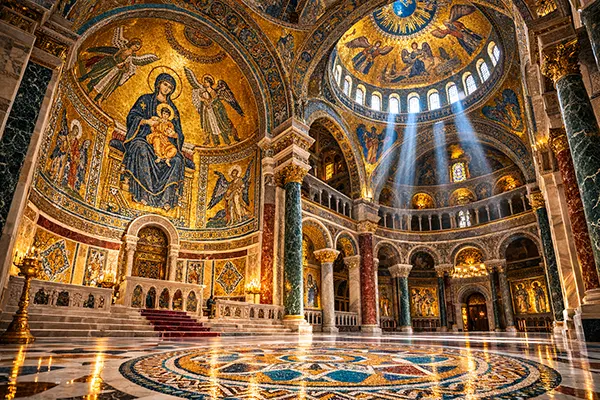
The Byzantine Empire transformed mosaic art into one of the most recognisable forms of religious imagery. Beginning in the fourth century CE, Christian churches increasingly used mosaics to decorate domes, apses and walls. Unlike Roman floor mosaics, Byzantine works often appeared on vertical surfaces and ceilings, making them visible to worshippers throughout the interior of a church.
Gold glass tesserae became a defining feature of Byzantine mosaics. Craftsmen placed thin sheets of gold between layers of glass, creating surfaces that reflected light dramatically. When illuminated by candles or natural sunlight entering through church windows, the mosaics produced a shimmering effect that enhanced the spiritual atmosphere of the building.
The themes of Byzantine mosaics were mainly religious. Artists depicted Christ, the Virgin Mary, saints and biblical narratives. The figures were often stylised rather than naturalistic, emphasising spiritual authority rather than physical realism.
Ravenna: A City of Extraordinary Mosaic Heritage
The Italian city of Ravenna contains some of the finest Byzantine mosaics preserved anywhere in the world. During the fifth and sixth centuries CE, Ravenna served as an important political and religious centre. Churches built during this period were decorated with complex mosaic cycles that remain largely intact.
The Basilica of San Vitale, completed in 547 CE, features famous mosaics depicting Emperor Justinian and Empress Theodora with their court. These compositions illustrate the close relationship between imperial authority and the Christian church. The figures appear against golden backgrounds, emphasising their symbolic status rather than realistic space.
Another remarkable monument is the Mausoleum of Galla Placidia. Its interior dome is covered with deep blue mosaics representing a starry sky. At the centre appears a golden cross, surrounded by hundreds of shining stars. The combination of colour, geometry and symbolism creates one of the most striking interiors in early Christian architecture.
Medieval and Later Mosaics Across Europe and the Middle East
Mosaic traditions continued throughout the Middle Ages in both Christian and Islamic architecture. In the Islamic world, artists adapted the technique to produce complex geometric and calligraphic designs rather than figurative imagery. The Great Mosque of Damascus, built in the early eighth century, originally featured magnificent mosaics showing idealised landscapes with rivers, trees and architectural forms.
In medieval Venice, mosaic decoration became a defining feature of the Basilica of St Mark. Constructed between the eleventh and thirteenth centuries, the church contains more than 8,000 square metres of mosaics. The interior surfaces are covered with golden backgrounds and narrative scenes drawn from biblical history.
The Renaissance brought renewed interest in classical art, but mosaics did not disappear. They continued to be used for monumental decoration in churches and public buildings. In Rome, St Peter’s Basilica contains large mosaic reproductions of famous paintings, created to ensure durability in the humid interior of the church.
Modern Appreciation and Preservation of Historic Mosaics
Today many ancient mosaics are preserved in museums or protected archaeological sites. Conservation specialists use advanced techniques to stabilise fragile surfaces and restore missing sections. Because mosaics consist of thousands of individual tesserae, restoration requires careful documentation and long-term research.
International organisations such as UNESCO play a role in protecting important mosaic monuments. Sites including Ravenna’s early Christian monuments, the Villa del Casale and the mosaics of Madaba in Jordan are recognised as World Heritage locations. Such recognition helps secure funding for conservation and encourages responsible tourism.
Modern artists also continue experimenting with mosaic techniques. Contemporary mosaics appear in public art projects, architectural decoration and community murals. While the materials and styles may evolve, the fundamental principle remains the same: small pieces assembled together to form images capable of lasting for centuries.